Ultrasound Gel Warmer Cleaning: A Fleet Handoff Audit
Same symptom on your system?
Tell us your model and what it is doing. A GEPROBE engineer replies with a diagnosis path, part options and pricing — usually within 6 hours, with no obligation.
Chat on WhatsApp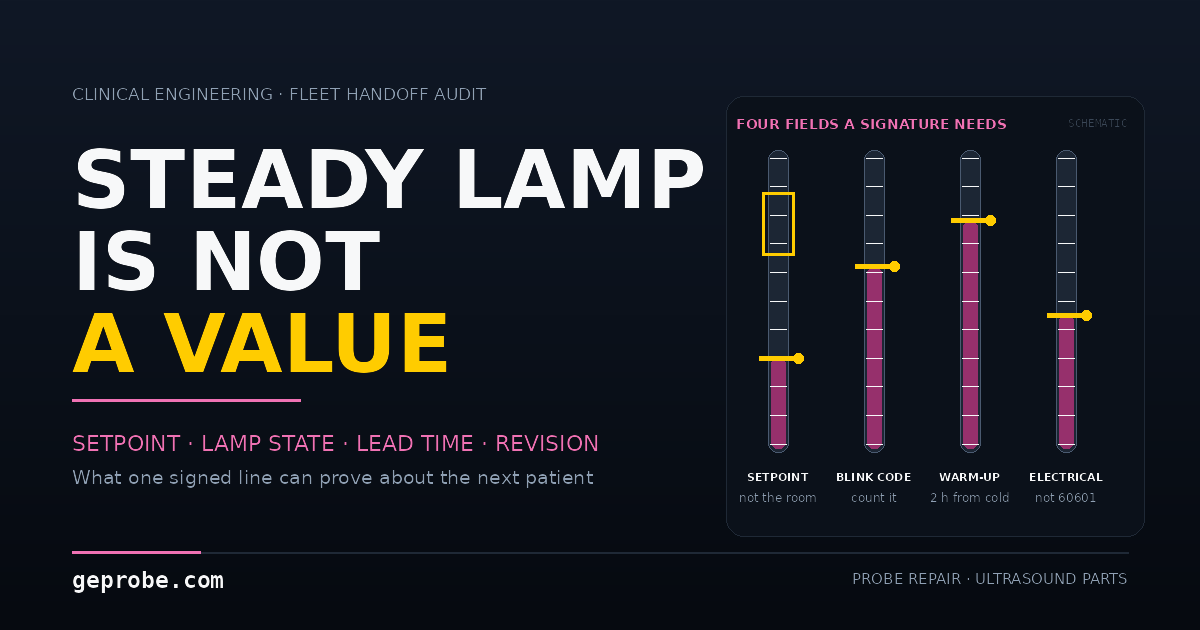
Ultrasound gel warmer cleaning gets argued as a wipe: which cloth, which disinfectant, whose rota. The harder question sits one layer down, because the thing being wiped is a thermostat with a mains plug attached.
Written for clinical engineering and HTM teams, sonography leads, and buyers taking a used cart into service. It stays out of gel selection and local infection-control schedules.
The question is narrower: given this specific model, what can a signed record prove about the gel the next patient receives?
Start with the setpoint, not the swab
There is no single "warmed gel" state. In one manufacturer's current instructions the target is a configuration with three shapes, and what the unit reports differs with it.
| Model family | Setpoint as stated | What it reports | Record field it supports |
|---|---|---|---|
| 82-01 single bottle, 12 W | 104 °F (40 °C), fixed | Lamp blinks while heating, steady at temperature | Lamp state, time, observer |
| 82-03 LED, 31 W | LOW / MED / HIGH, MEDIUM at first power-up | LED bank flashing, steady at setpoint | Setpoint band, retained setting |
| 83-03 LCD, 31 W | 97–109 °F (36–43 °C), 1 °F steps | Numeric reading, E1 or E2 on fault | Value, time, method |
The LED instructions warn that HIGH must not be used on infants, the elderly, or patients with very sensitive skin (PM-082-0003H — reviewed 2026-11-28).
That makes setpoint a patient-population decision, not a room decision.
The multi-bottle instructions also state that the unit recalls the last setting when power returns. A warmer wheeled from a paediatric room to an adult clinic, or between campuses, resumes the setpoint of the room it left.
That turns setpoint into a transfer problem. The receiving site reads the setting instead of assuming a default.
What the lamp can and cannot tell you
The single-bottle unit has no thermometer. Its heat lamp blinks while the unit approaches set temperature, stays lit once reached, and blinks again if heating restarts (PM-082-0001H — reviewed 2026-11-28).
So a steady lamp is a state, not a measurement. It reports that the thermostat believes it has arrived, and it cannot be quoted as a value.
The instructions hedge the same way: temperature can vary, and a small quantity should be tested before applying.
No drift tolerance is published anywhere in the document, so any band written into a facility record is the facility's own assumption.
The fault grammar is stated precisely and differs by family.
A failed sensor blinks once every five seconds; a short circuit blinks twice; in either circumstance the heater will not operate.
The LED multi-bottle unit counts those blinks on the LED bank, while the LCD unit shows E1 or E2. Both families disable the heater.
Most checklists ask for "no error codes". On the two families without a display that line reads clean whenever nobody counted blinks, and a warm-up blink looks like a fault blink to anyone not counting.
Record the state itself: lamp or LED, steady or flashing, counted at a stated time.
The hazard is quiet. A disabled heater leaves a capped bottle sitting in a well still warm from the last cycle, so the room reads as warmed and the gel is at room temperature.
Two hours of lead time is a scheduling fact
Both instruction sets state that a full bottle needs approximately two hours to reach proper temperature.
Plugged in at 08:00 in a newly occupied room, warmed gel arrives at about 10:00. Where a site powers units down overnight, that lead time lands inside the first list block every day.
wells_needed = ceil( bottles_per_hour x warm_up_hours x safety / bottles_per_well_per_cycle )
example:      ceil( 2.5 x 2.0 x 1.2 / 1 ) = 6 wells
A clinic drawing 2.5 bottles per clinical hour, with a two-hour warm-up and a 20 percent buffer, needs six wells before it serves its first patient with warmed gel.
A four-well unit covers four of them, so either a second unit or an explicit decision to begin cold.
Note the denominator. The arithmetic counts wells, not appliances, and room count is how fleets get over-ordered and still run dry at 08:30.
The electrical baseline is not the probe's baseline
The declaration of conformity lists BS EN 60335-1:2012/A16:2023 and BS EN 60335-2-15:2016/A12:2021, with EN 62233:2008, EN IEC 60664-1:2020, and the UK Electrical Equipment (Safety) and EMC Regulations 2016.
That is the household and similar-appliance safety series, whose general part lists what it does not cover — medical electrical equipment under the IEC 60601 series among them (BS EN IEC 60335-1 scope — reviewed 2026-11-28).
This is not a defect: the appliance is declaring the framework it was tested against, which differs from the transducer's.
The consequence for a PM template is concrete. A procedure organised around 60601 applied-part classification and patient leakage currents measures against a standard this appliance never claimed.
What it does claim is what actually fails: grounded outlets only; never run a unit with a damaged cord or plug or one that has malfunctioned; return it to an authorised service facility.
Ratings make the failure profile plain: 12 W at 0.1 A for the single-bottle model, 31 W for the multi-bottle, so the element is not where these fail.
The envelope is specified too: 20 °C to 35 °C ambient, humidity to 80 percent non-condensing, Installation Category II, altitude to 6,500 feet (PM-082-0003H — reviewed 2026-11-28).
A warmer installed over a radiator sits outside its own envelope.
And "no routine maintenance is required" concerns who may open the device, not whether the appliance gets a scheduled check; that interval is a facility decision.
The label that the cleaning method attacks
Cleaning is specified narrowly. Disconnect from the outlet and let the unit cool.
Then wipe with a soft, only-damp cloth and a mild detergent or hospital-grade product: no liquid in the controls, no abrasive cleaner, no isopropyl alcohol, no immersion.
The asset label sits on that housing, under a regimen forbidding the two things labels handle worst: abrasion and solvent.
So specify a material and adhesive rated for repeated wiping with the approved disinfectant, placed clear of the controls and the cord entry.
Then add what survives label loss: photograph the rear electrical information label at intake, and file the image against the register row.
Where a printed listing and the label on the appliance disagree about model or voltage, the label wins.
Across sites, keep one row per physical unit, searchable by serial, because asset IDs are site-local and rarely survive a transfer intact.
Minimum fields: serial, model code, voltage, setpoint and who authorised it, revision verified, last lamp or LED state, last cleaning date, named owner, status. Room binders do not travel; the serial number does.
Buy, repair, or replace
| Situation at handoff | Action | Owner |
|---|---|---|
| Label legible, lamp steady, cord intact, revision matches | Release, log state and setpoint | Department and biomed |
| Blink pattern, E1 or E2, heater not operating | Out of service, gel in the well is cold | Biomed |
| Damaged cord or plug, or evidence of disassembly | Out of service, route to the warmer maker | Biomed |
| Rear label abraded, model or voltage unreadable | Cannot be tied to an instruction, replace or get written confirmation | Biomed, procurement |
| Warmer sound, practice conflicts with local policy | Not a device fault, escalate the practice | IPC and department lead |
Compare per well, per year:
cost_per_well_year = ( unit + installation + cleaning + checks + reserve ) / ( wells x service_life_years )Unit and installation prices are supplier quotes, unverified here. The formula divides by wells, because a four-well unit and a one-well unit are not comparable per device.
Two facts push the decision: no user-serviceable parts, and disassembly voids the two-year warranty. A faulted unit is usually a swap, and paying a technician to open one is how a cheap appliance becomes expensive.
Who signs the release
Three signatures, three attestations, no substitutions.
The using department attests that cleaning was completed and the lamp state counted. Biomed attests electrical intake, the authorised setpoint, and the register row.
Infection prevention attests that gel type, container, and warming itself are permitted in that clinical area.
On a transfer, the receiving site countersigns, because the setpoint travels with the unit while the local policy does not.
An unsigned line is a hold, not a maybe. The usual failure is not a missed task but a signature given in the belief that another signature covered it.
- Serial and model read from the appliance, not the binder — sign: biomed
- Setpoint recorded with the patient population it was set for — sign: department lead
- Revision verified against the current manufacturer listing — sign: biomed
- Lamp or LED state counted and timed, steady or flashing — sign: using department
- Fault pattern, E1 or E2 logged, unit removed from service — sign: biomed
- Rear electrical label photographed and filed — sign: biomed
- Grounded outlet confirmed, cord and plug inspected — sign: biomed
- Cleaning done by the approved method, no solvent or abrasive — sign: using department
- Warming permitted here, per policy and gel type — sign: IPC
- Receiving site countersigned on transfer, setpoint re-verified — sign: receiving lead
Where the audit stops being about the warmer
A walk-round that starts at the warmer often ends somewhere else. Lens delamination, element dropout, or a strained cable at the connector is a transducer problem, and it belongs on a probe bench rather than in a warmer record.
That part is ours: endoscope-style and TEE probes, endocavity and 4D volume transducers, element arrays, acoustic lens caps, cable and strain relief, connector pins and EEPROM.
Plus leak test certification, a free evaluation, and a test report with a cosmetic checklist. See probe repair and ultrasound parts.
To be specific: GEPROBE does not supply, stock, or service gel warmers. Everything above describing a warmer is an audit method, not a service offer.
What the audit does not establish
It does not crown any temperature as clinically superior.
The warmer maker states that warming will not affect the performance or viscosity of its own gels. No peer-reviewed acoustic measurement was located for this review, so coupling reasoning stays mechanism, not evidence.
It does not set a cleaning interval either. Guidance calls for periodic cleaning and disinfection, with cadence set by the maker's directions and local infection-control rules (AIUM 2025 revision — reviewed 2026-11-28).
It also advises against warming gel at all, unless a clinical benefit credibly beats using it at room temperature (UKHSA — reviewed 2026-11-28).
What it establishes is narrower: most of what a handoff needs is visible on the front panel and legible on the back label, and none of it fits a tick-box saying the room was cleaned.
Sources
- Parker PM-082-0001H single-bottle instructions — reviewed 2026-11-28.
- Parker PM-082-0003H multi-bottle instructions — reviewed 2026-11-28.
- AIUM transducer and coupling gel guidelines, 2025 revision — reviewed 2026-11-28.
- UKHSA using ultrasound gel, updated 30 January 2025 — reviewed 2026-11-28.
- BS EN IEC 60335-1 scope, ANSI preview — reviewed 2026-11-28.
- GEPROBE probe repair and ultrasound parts — reviewed 2026-11-28.
Related Articles
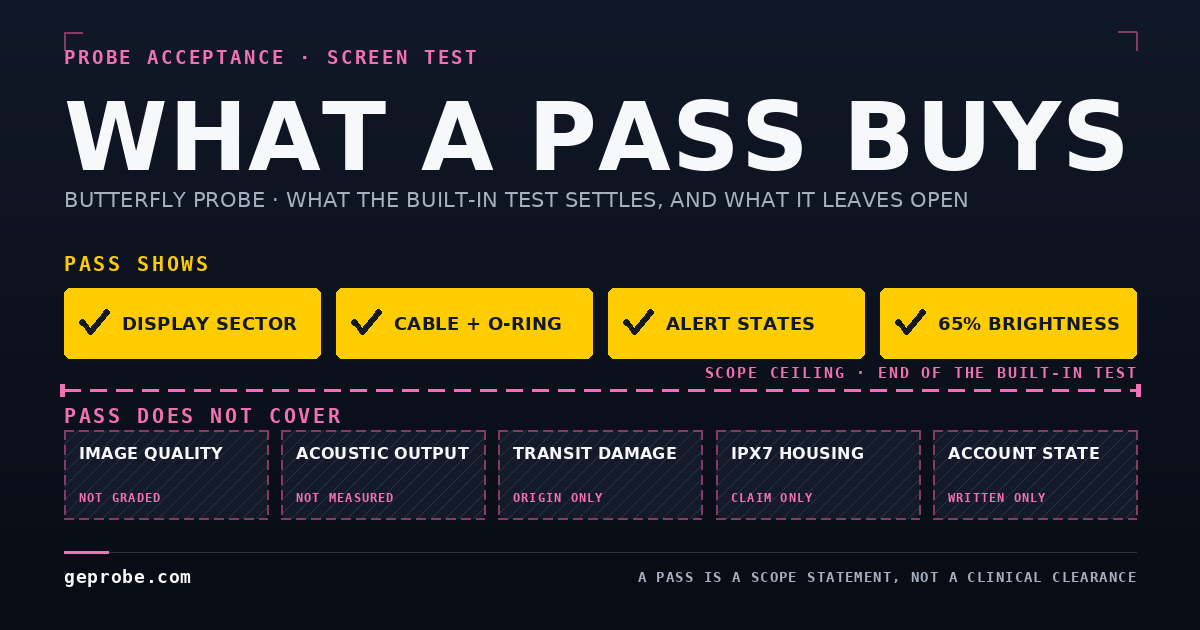
Butterfly Probe Diagnostics Acceptance: What a Pass Buys
A probe self-test clears one line of a kit acceptance record. Here are the other six lines, a ten-minute panel check, and a price formula you can defend.
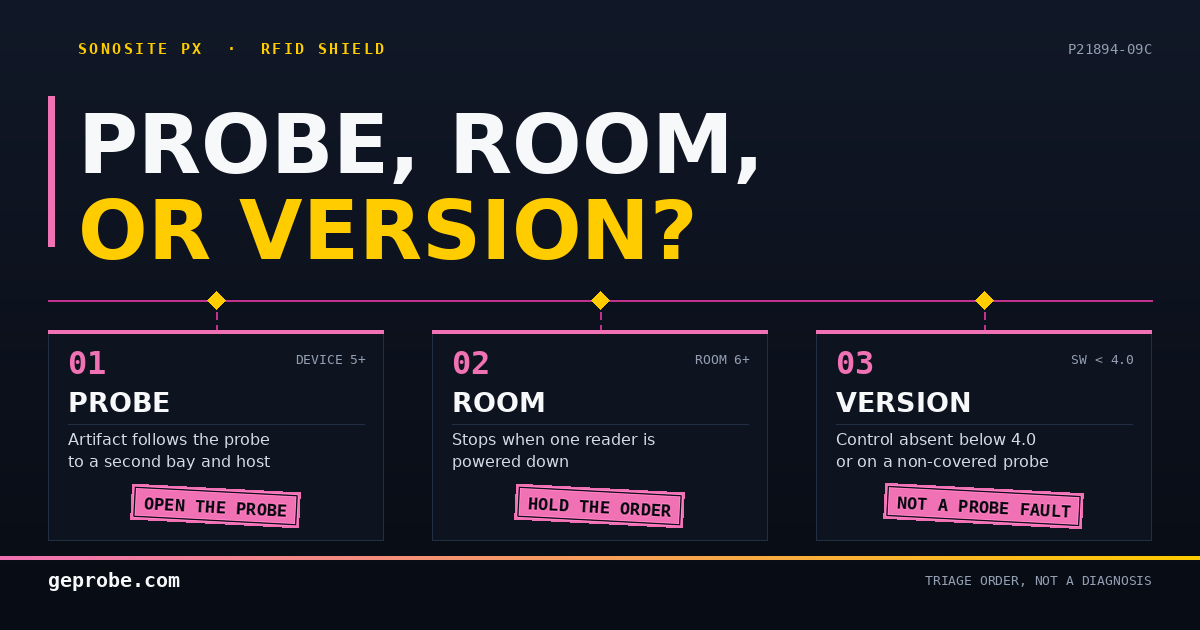
Sonosite PX RFID interference: probe, room, or version?
Before you buy a probe or a board for a Sonosite PX, run the eligibility check and a scored room-versus-device bench matrix. The order that saves parts.
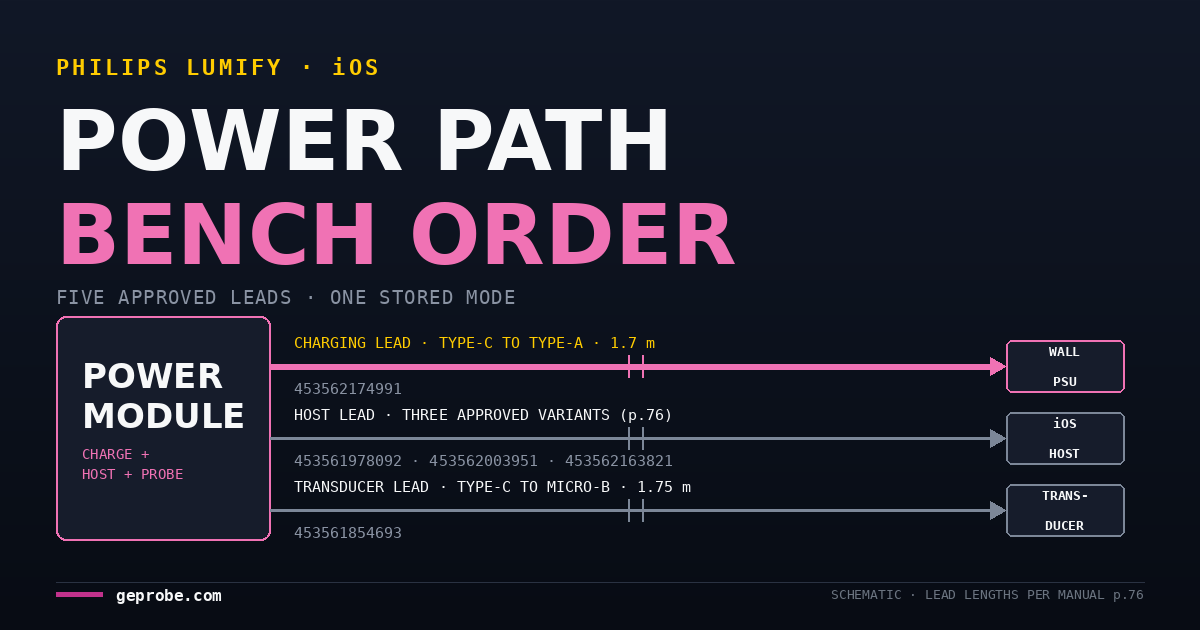
Philips Lumify iOS cable: a bench order of operations
Which leads a Lumify iOS kit needs, how to prove the charging path on the bench, and how to grade a used Power Module before paying.